
Key Takeaways:
- Liquidity is Survival: Without active market making, tokens suffer from “thin” order books, causing massive price swings even on small trades.
- Automation is Mandatory: 89% of global crypto volume is now handled by algorithmic bots that react to volatility in milliseconds.
- SGE Priority: Modern SEO for token projects requires clear, data-backed explanations of liquidity metrics to rank in AI-generated overviews.
- Cost-Efficiency: Modern solutions like Token Market Maker have replaced expensive monthly retainer models with one-time setup fees.
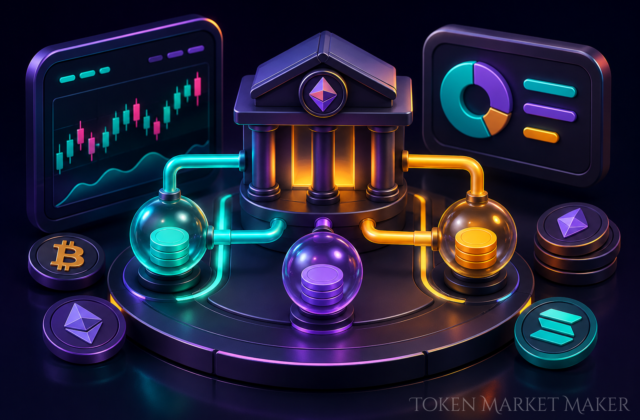
Crypto market making is the process of providing simultaneous buy and sell orders for a digital asset to ensure high liquidity and price stability. In 2026, market making has evolved from a manual trading desk activity into a sophisticated, AI-driven necessity for every token project aiming to minimize slippage and maintain a healthy bid-ask spread.
How Crypto Market Making Works
At its core, a market maker acts as the “middleman” of the order book. By constantly placing limit orders on both sides of the market, they ensure that any buyer or seller can execute a trade at any time without waiting for a natural counterparty.
The Mechanics of the Bid-Ask Spread
The bid-ask spread is the gap between the highest price a buyer is willing to pay (bid) and the lowest price a seller is willing to accept (ask). Market makers earn a profit—or “capture the spread”—by buying at the bid and selling at the ask. For token projects, a tight spread (typically <0.5% on major exchanges) is a sign of a healthy, mature ecosystem.
Liquidity Provision Crypto Strategies
- Delta Neutrality: Balancing buys and sells to avoid exposure to price fluctuations of the underlying asset.
- Order Layering: Placing multiple orders at different price levels to deepen the order book.
- Cross-Exchange Arbitrage: Syncing liquidity across multiple CEXs and DEXs to prevent price disparities.
The 2026 Market Maker Bot vs. Manual Trading
In the current landscape, manual market making is obsolete. The speed of AI-driven high-frequency trading (HFT) means that human traders cannot compete with the execution precision of a market maker bot 2026 edition.
| Feature | Manual Trading | Algorithmic Bot (2026) |
| Execution Speed | Seconds to Minutes | <10 Milliseconds |
| Uptime | Limited by human endurance | 24/7/365 |
| Emotional Bias | High (Fear/Greed) | Zero (Rules-based) |
| Scalability | 1-2 trading pairs | 40+ tokens across 20+ exchanges |
| Cost Basis | High Salaries/Commissions | Low Server Fees/One-time Setup |
Liquidity Intelligence: The Strategic Outlook
The most significant shift in 2026 is the transition from “Static Liquidity” to “Predictive Liquidity.” Based on current data from CoinGecko and DeFiLlama, liquidity is no longer just about volume; it is about depth-to-volatility ratios.
The Strategic Insight: In 2026, tokens that rely solely on “locked” liquidity in DEX pools are failing. The market now rewards projects that use Hybrid Liquidity Management. This involves using an automated bot to “mimic” organic activity on CEXs while providing concentrated liquidity on V3 DEXs. This dual-layered approach reduces the “Liquidity Tax” on projects by 40%, allowing them to maintain stable prices with significantly less capital.
Why Token Projects Need a Market Maker Explained
Without a dedicated market maker, a token project faces several critical risks:
- Flash Crashes: A single large sell order can wipe out 20-30% of a token’s value if the order book is thin.
- Exchange Delisting: Most Tier-1 exchanges (Binance, Bybit, OKX) require minimum liquidity thresholds to maintain a listing.
- Investor Distrust: High slippage prevents institutional investors from entering a position, as they cannot enter or exit without moving the price.
FAQs
What is the difference between a market maker and a trader?
A trader usually seeks to profit from price direction (long or short), whereas a market maker aims to remain “market neutral,” profiting from the spread and providing the infrastructure for others to trade.
How much does crypto market making cost in 2026?
Traditional firms still charge $5,000–$15,000 per month. However, automated bot solutions have lowered the barrier to entry, offering one-time setup fees starting around $8,500 with minimal hosting costs.
Can a market maker bot work on decentralized exchanges (DEX)?
Yes. Modern bots are cross-compatible, managing liquidity on CEXs like Binance and injecting liquidity into DEXs like Uniswap V3 or PancakeSwap simultaneously to maintain price parity.
Ready to give your token the liquidity it deserves? Token Market Maker is a fully automated market making bot that works across 40+ tokens and 20+ exchanges with a one-time fee from $8,500 no monthly charges. Start with a free 3-day trial, no payment required, deployed in 24-48 hours. Apply at tokenmarketmaker.io/apply