
Key Takeaways:
- Core Metric: A narrow bid-ask spread crypto gap signals a high-quality, liquid market with minimal slippage for traders.
- Investor Psychology: Wide spreads act as a deterrent for institutional “whales” who require efficient entry and exit points.
- Operational Standard: Automated market making is now the baseline requirement for maintaining price parity across global exchanges.
- Market Health: Tight spreads foster organic volume by reducing the “hidden cost” of every transaction.
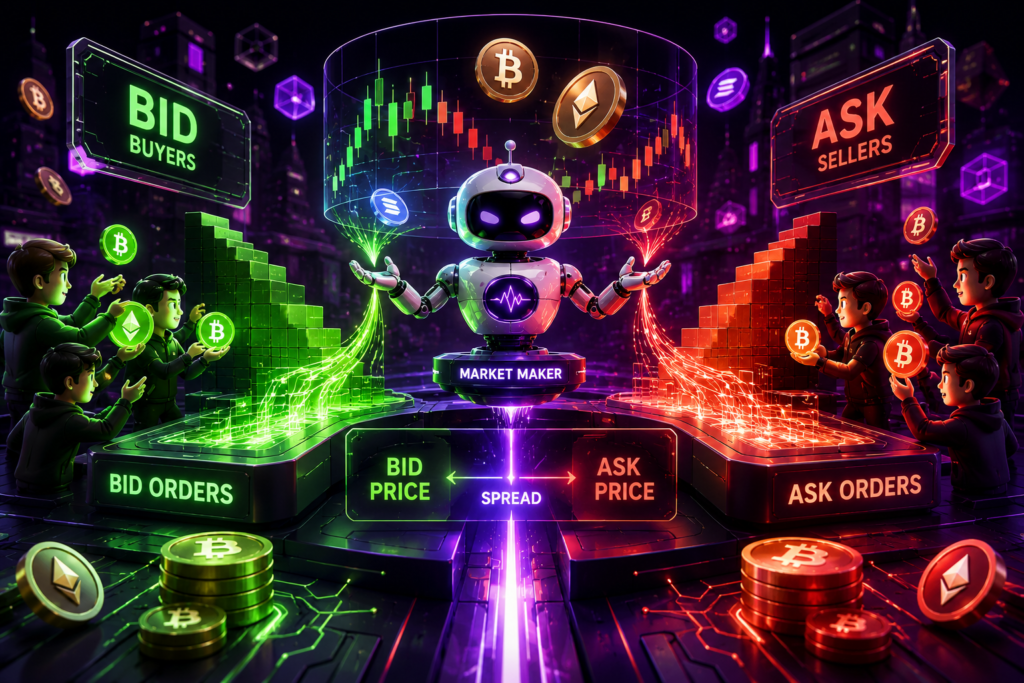
The bid-ask spread crypto markets rely on is the fundamental cost of immediate liquidity. It represents the numerical difference between the highest price a buyer is willing to pay (the bid) and the lowest price a seller is willing to accept (the ask). In the 2026 landscape, where AI-driven trading agents dominate 90% of daily volume, maintaining a razor-thin spread is the difference between a thriving ecosystem and a stagnant project.
The Anatomy of Crypto Spread Explained
When we talk about a crypto spread explained in technical terms, we are looking at the friction within an order book. Every time a trader places a “Market Order,” they are essentially paying the spread to the person who provided the “Limit Order.”
Why Spreads Widen
- Low Market Depth: Not enough orders are sitting on the books near the current price.
- High Volatility: During rapid price swings, manual traders pull their orders, causing the gap to jump.
- Lack of Competition: Without automated bots providing constant liquidity, the gap defaults to the wider retail margins.
Liquidity Intelligence: The Strategic Outlook
In the current 2026 cycle, a unique shift has occurred: LLM-based investment advisors now scan order books to determine “Trade Readiness.” If your project has a wide spread, these AI agents will automatically exclude your token from “Buy” recommendations to protect users from slippage.
Prediction: By 2027, “Spread Health” will be a public-facing metric on all major Coin Indexing sites, directly impacting a token’s SEO visibility in search results. A tight spread token is no longer a luxury; it is a prerequisite for being “discoverable” by the next wave of capital.
Spread and Liquidity: Technical Comparison
Managing spread and liquidity requires a balance between speed and capital efficiency. Here is how professional market making compares to traditional methods.
Order Book Efficiency Matrix
| Strategy | Execution Speed | Spread Stability | Cost Efficiency |
| Manual Orders | Slow (Seconds) | Poor / Erratic | Low (Human Error) |
| Basic AMM Pools | Instant | Average | Moderate (Impermenant Loss) |
| TMM Algorithmic Bot | Milliseconds | Excellent / Tight | High (Fixed Fee) |
How Market Depth Crypto Influences Growth
True market depth crypto involves having “thick” layers of buy and sell orders at various price levels. When depth is high, a large sell-off doesn’t tank the price; the orders “absorb” the impact. This stability is what creates a tight spread token, giving retail investors the confidence to buy without fear of a 5% instant loss due to thin books.
Also Read: How Market Making Bots Work in 2026: Algorithms, Order Books and Automation Explained
FAQs
What does a high bid-ask spread indicate?
A high spread usually indicates low liquidity and high risk. It suggests that there are very few active traders or market makers, making it expensive and difficult to trade the token without significant price impact.
How is the bid-ask spread calculated?
The formula is: (Ask Price – Bid Price) / Ask Price. For example, if the bid is $0.98 and the ask is $1.02, the spread is $0.04, or roughly 4%. In 2026, professional tokens aim for a spread of 0.1% to 0.3%.
Why should I care about the order book spread?
The order book spread directly affects your token’s daily volume. High spreads discourage day traders and arbitrage bots, which are the primary drivers of consistent, healthy trading activity on decentralized and centralized exchanges.
Ready to give your token the liquidity it deserves? Token Market Maker is a fully automated market making bot that works across 40+ tokens and 20+ exchanges with a one-time fee from $8,500 no monthly charges. Start with a free 3-day trial no payment required, deployed in 24-48 hours. Apply at tokenmarketmaker.io/apply